A class for drawing transient features (e.g. More...
#include <qgsrubberband.h>
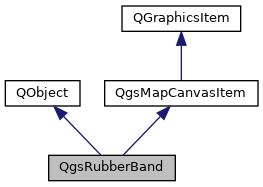
Public Types | |
| enum | IconType { ICON_NONE , ICON_CROSS , ICON_X , ICON_BOX , ICON_CIRCLE , ICON_FULL_BOX , ICON_DIAMOND , ICON_FULL_DIAMOND , ICON_SVG } |
| Icons. More... | |
Public Member Functions | |
| QgsRubberBand (QgsMapCanvas *mapCanvas, Qgis::GeometryType geometryType=Qgis::GeometryType::Line) | |
| Creates a new RubberBand. More... | |
| ~QgsRubberBand () override | |
| void | addGeometry (const QgsGeometry &geometry, const QgsCoordinateReferenceSystem &crs=QgsCoordinateReferenceSystem(), bool doUpdate=true) |
| Adds a geometry to the rubberband. More... | |
| void | addGeometry (const QgsGeometry &geometry, QgsMapLayer *layer, bool doUpdate=true) |
| Adds the geometry of an existing feature to a rubberband This is useful for multi feature highlighting. More... | |
| void | addPoint (const QgsPointXY &p, bool doUpdate=true, int geometryIndex=0, int ringIndex=0) |
| Adds a vertex to the rubberband and update canvas. More... | |
| QgsGeometry | asGeometry () const |
| Returns the rubberband as a Geometry. More... | |
| void | closePoints (bool doUpdate=true, int geometryIndex=0, int ringIndex=0) |
| Ensures that a polygon geometry is closed and that the last vertex equals the first vertex. More... | |
| void | copyPointsFrom (const QgsRubberBand *other) |
| Copies the points from another rubber band. More... | |
| QColor | fillColor () const |
| Returns the current fill color. More... | |
| const QgsPointXY * | getPoint (int i, int j=0, int ringIndex=0) const |
| Returns a vertex. More... | |
| IconType | icon () const |
| Returns the current icon type to highlight point geometries. More... | |
| int | iconSize () const |
| Returns the current icon size of the point icons. More... | |
| void | movePoint (const QgsPointXY &p, int geometryIndex=0, int ringIndex=0) |
| Moves the rubber band point specified by index. More... | |
| void | movePoint (int index, const QgsPointXY &p, int geometryIndex=0, int ringIndex=0) |
| Moves the rubber band point specified by index. More... | |
| int | numberOfVertices () const |
| Returns count of vertices in all lists of mPoint. More... | |
| int | partSize (int geometryIndex) const |
| Returns number of vertices in feature part. More... | |
| void | removeLastPoint (int geometryIndex=0, bool doUpdate=true, int ringIndex=0) |
| Removes the last point. More... | |
| void | removePoint (int index=0, bool doUpdate=true, int geometryIndex=0, int ringIndex=0) |
| Removes a vertex from the rubberband and (optionally) updates canvas. More... | |
| void | reset (Qgis::GeometryType geometryType=Qgis::GeometryType::Line) |
| Clears all the geometries in this rubberband. More... | |
| QColor | secondaryStrokeColor () const |
| Returns the current secondary stroke color. More... | |
| void | setBrushStyle (Qt::BrushStyle brushStyle) |
| Sets the style of the brush. More... | |
| void | setColor (const QColor &color) |
| Sets the color for the rubberband. More... | |
| void | setFillColor (const QColor &color) |
| Sets the fill color for the rubberband. More... | |
| void | setIcon (IconType icon) |
| Sets the icon type to highlight point geometries. More... | |
| void | setIconSize (int iconSize) |
| Sets the size of the point icons. More... | |
| void | setLineStyle (Qt::PenStyle penStyle) |
| Sets the style of the line. More... | |
| void | setSecondaryStrokeColor (const QColor &color) |
| Sets a secondary stroke color for the rubberband which will be drawn under the main stroke color. More... | |
| void | setStrokeColor (const QColor &color) |
| Sets the stroke color for the rubberband. More... | |
| void | setSvgIcon (const QString &path, QPoint drawOffset) |
| Set the path to the svg file to use to draw points. More... | |
| void | setSymbol (QgsSymbol *symbol) |
| Sets the symbol used for rendering the rubberband. More... | |
| void | setToCanvasRectangle (QRect rect) |
| Sets this rubber band to a map canvas rectangle. More... | |
| void | setToGeometry (const QgsGeometry &geom, QgsVectorLayer *layer) |
| Sets this rubber band to geom. More... | |
| void | setToGeometry (const QgsGeometry &geometry, const QgsCoordinateReferenceSystem &crs=QgsCoordinateReferenceSystem()) |
| Sets this rubber band to geometry. More... | |
| void | setTranslationOffset (double dx, double dy) |
| Adds translation to original coordinates (all in map coordinates) More... | |
| void | setWidth (int width) |
| Sets the width of the line. More... | |
| int | size () const |
| Returns number of geometries. More... | |
| QColor | strokeColor () const |
| Returns the current stroke color. More... | |
| QgsSymbol * | symbol () const |
| Returns the symbol used for rendering the rubberband, if set. More... | |
| void | updatePosition () override |
| called on changed extent or resize event to update position of the item More... | |
| int | width () const |
| Returns the current width of the line or stroke width for polygon. More... | |
 Public Member Functions inherited from QgsMapCanvasItem Public Member Functions inherited from QgsMapCanvasItem | |
| QRectF | boundingRect () const override |
| QgsRectangle | rect () const |
| returns canvas item rectangle in map units More... | |
| void | setRect (const QgsRectangle &r, bool resetRotation=true) |
| sets canvas item rectangle in map units More... | |
| QPointF | toCanvasCoordinates (const QgsPointXY &point) const |
| transformation from map coordinates to screen coordinates More... | |
| QgsPointXY | toMapCoordinates (QPoint point) const |
| transformation from screen coordinates to map coordinates More... | |
| virtual void | updatePosition () |
| called on changed extent or resize event to update position of the item More... | |
Protected Member Functions | |
| void | drawShape (QPainter *p, const QVector< QPointF > &pts) |
| Draws shape of the rubber band. More... | |
| void | drawShape (QPainter *p, const QVector< QPolygonF > &rings) |
| Draws shape of the rubber band. More... | |
| void | paint (QPainter *p) override |
| Paints the rubber band in response to an update event. More... | |
| void | updateRect () |
| Recalculates needed rectangle. More... | |
| Protected Member Functions inherited from QgsMapCanvasItem | |
| QgsMapCanvasItem (QgsMapCanvas *mapCanvas) | |
| protected constructor: cannot be constructed directly More... | |
| ~QgsMapCanvasItem () override | |
| virtual void | paint (QPainter *painter)=0 |
| function to be implemented by derived classes More... | |
| void | paint (QPainter *painter, const QStyleOptionGraphicsItem *option, QWidget *widget=nullptr) override |
| bool | setRenderContextVariables (QPainter *p, QgsRenderContext &context) const |
| Sets render context parameters. More... | |
| void | updateCanvas () |
| schedules map canvas for repaint More... | |
Properties | |
| QColor | fillColor |
| int | iconSize |
| QColor | secondaryStrokeColor |
| QColor | strokeColor |
| int | width |
Additional Inherited Members | |
| Protected Attributes inherited from QgsMapCanvasItem | |
| QSizeF | mItemSize |
| cached size of the item (to return in boundingRect()) More... | |
| QgsMapCanvas * | mMapCanvas = nullptr |
| pointer to map canvas More... | |
| QgsRectangle | mRect |
| cached canvas item rectangle in map coordinates encodes position (xmin,ymax) and size (width/height) used to re-position and re-size the item on zoom/pan while waiting for the renderer to complete. More... | |
| double | mRectRotation |
Detailed Description
A class for drawing transient features (e.g.
digitizing lines) on the map.
The QgsRubberBand class provides a transparent overlay widget for tracking the mouse while drawing polylines or polygons.
Definition at line 53 of file qgsrubberband.h.
Member Enumeration Documentation
◆ IconType
Icons.
Definition at line 84 of file qgsrubberband.h.
Constructor & Destructor Documentation
◆ QgsRubberBand()
| QgsRubberBand::QgsRubberBand | ( | QgsMapCanvas * | mapCanvas, |
| Qgis::GeometryType | geometryType = Qgis::GeometryType::Line |
||
| ) |
Creates a new RubberBand.
- Parameters
-
mapCanvas The map canvas to draw onto. Its CRS will be used to map points onto screen coordinates. The ownership is transferred to this canvas. geometryType Defines how the data should be drawn onto the screen. Qgis::GeometryType::Line, Qgis::GeometryType::Polygon or Qgis::GeometryType::Point
Definition at line 31 of file qgsrubberband.cpp.
◆ ~QgsRubberBand()
|
overridedefault |
Member Function Documentation
◆ addGeometry() [1/2]
| void QgsRubberBand::addGeometry | ( | const QgsGeometry & | geometry, |
| const QgsCoordinateReferenceSystem & | crs = QgsCoordinateReferenceSystem(), |
||
| bool | doUpdate = true |
||
| ) |
Adds a geometry to the rubberband.
If crs is specified, the geometry will be automatically reprojected from crs to the canvas CRS.
If additional geometries are to be added then set doUpdate to false to defer costly repaint and bounding rectangle calculations for better performance. After adding the final geometry updatePosition() should be called.
Definition at line 307 of file qgsrubberband.cpp.
◆ addGeometry() [2/2]
| void QgsRubberBand::addGeometry | ( | const QgsGeometry & | geometry, |
| QgsMapLayer * | layer, | ||
| bool | doUpdate = true |
||
| ) |
Adds the geometry of an existing feature to a rubberband This is useful for multi feature highlighting.
As of 2.0, this method does not change the GeometryType any more. You need to set the GeometryType of the rubberband explicitly by calling reset() or setToGeometry() with appropriate arguments. setToGeometry() is also to be preferred for backwards-compatibility.
If additional geometries are to be added then set doUpdate to false to defer costly repaint and bounding rectangle calculations for better performance. After adding the final geometry updatePosition() should be called.
- Parameters
-
geometry the geometry object. Will be treated as a collection of vertices. layer the layer associated with the geometry. This is used for transforming the geometry from the layer's CRS to the map crs. If layer is nullptrno coordinate transformation will occur.doUpdate set to falseto defer updates of the rubber band.
Definition at line 288 of file qgsrubberband.cpp.
◆ addPoint()
| void QgsRubberBand::addPoint | ( | const QgsPointXY & | p, |
| bool | doUpdate = true, |
||
| int | geometryIndex = 0, |
||
| int | ringIndex = 0 |
||
| ) |
Adds a vertex to the rubberband and update canvas.
The rendering of the vertex depends on the current GeometryType and icon. If adding more points consider using update=false for better performance
- Parameters
-
p The vertex/point to add doUpdate Should the map canvas be updated immediately? geometryIndex The index of the feature part (in case of multipart geometries) ringIndex The index of the polygon ring (in case of polygons with holes)
Definition at line 118 of file qgsrubberband.cpp.
◆ asGeometry()
| QgsGeometry QgsRubberBand::asGeometry | ( | ) | const |
Returns the rubberband as a Geometry.
- Returns
- A geometry object which reflects the current state of the rubberband.
Definition at line 746 of file qgsrubberband.cpp.
◆ closePoints()
| void QgsRubberBand::closePoints | ( | bool | doUpdate = true, |
| int | geometryIndex = 0, |
||
| int | ringIndex = 0 |
||
| ) |
Ensures that a polygon geometry is closed and that the last vertex equals the first vertex.
- Parameters
-
doUpdate set to trueto update the map canvas immediatelygeometryIndex The index of the feature part (in case of multipart geometries) ringIndex The index of the polygon ring (in case of polygons with holes)
Definition at line 176 of file qgsrubberband.cpp.
◆ copyPointsFrom()
| void QgsRubberBand::copyPointsFrom | ( | const QgsRubberBand * | other | ) |
Copies the points from another rubber band.
- Since
- QGIS 3.22
Definition at line 439 of file qgsrubberband.cpp.
◆ drawShape() [1/2]
|
protected |
Draws shape of the rubber band.
- Parameters
-
p The QPainter object pts A list of points used to draw the shape
Definition at line 547 of file qgsrubberband.cpp.
◆ drawShape() [2/2]
|
protected |
Draws shape of the rubber band.
- Parameters
-
p The QPainter object rings A list of points used to draw the shape
Definition at line 530 of file qgsrubberband.cpp.
◆ fillColor()
|
inline |
Returns the current fill color.
Definition at line 161 of file qgsrubberband.h.
◆ getPoint()
| const QgsPointXY * QgsRubberBand::getPoint | ( | int | i, |
| int | j = 0, |
||
| int | ringIndex = 0 |
||
| ) | const |
Returns a vertex.
- Parameters
-
i The geometry index j The vertex index within ring ringIndex ringIndex The ring index within geometry i
Definition at line 735 of file qgsrubberband.cpp.
◆ icon()
|
inline |
Returns the current icon type to highlight point geometries.
Definition at line 216 of file qgsrubberband.h.
◆ iconSize()
|
inline |
Returns the current icon size of the point icons.
Definition at line 226 of file qgsrubberband.h.
◆ movePoint() [1/2]
| void QgsRubberBand::movePoint | ( | const QgsPointXY & | p, |
| int | geometryIndex = 0, |
||
| int | ringIndex = 0 |
||
| ) |
Moves the rubber band point specified by index.
Note that if the rubber band is not used to track the last mouse position, the first point of the rubber band has two vertices
Definition at line 232 of file qgsrubberband.cpp.
◆ movePoint() [2/2]
| void QgsRubberBand::movePoint | ( | int | index, |
| const QgsPointXY & | p, | ||
| int | geometryIndex = 0, |
||
| int | ringIndex = 0 |
||
| ) |
Moves the rubber band point specified by index.
Note that if the rubber band is not used to track the last mouse position, the first point of the rubber band has two vertices
Definition at line 248 of file qgsrubberband.cpp.
◆ numberOfVertices()
| int QgsRubberBand::numberOfVertices | ( | ) | const |
Returns count of vertices in all lists of mPoint.
- Returns
- The total number of vertices
Definition at line 722 of file qgsrubberband.cpp.
◆ paint()
|
overrideprotectedvirtual |
Paints the rubber band in response to an update event.
- Parameters
-
p The QPainter object
Implements QgsMapCanvasItem.
Definition at line 447 of file qgsrubberband.cpp.
◆ partSize()
| int QgsRubberBand::partSize | ( | int | geometryIndex | ) | const |
Returns number of vertices in feature part.
- Parameters
-
geometryIndex The index of the feature part (in case of multipart geometries)
- Returns
- number of vertices
Definition at line 713 of file qgsrubberband.cpp.
◆ removeLastPoint()
| void QgsRubberBand::removeLastPoint | ( | int | geometryIndex = 0, |
| bool | doUpdate = true, |
||
| int | ringIndex = 0 |
||
| ) |
Removes the last point.
Most useful in connection with undo operations
Definition at line 227 of file qgsrubberband.cpp.
◆ removePoint()
| void QgsRubberBand::removePoint | ( | int | index = 0, |
| bool | doUpdate = true, |
||
| int | geometryIndex = 0, |
||
| int | ringIndex = 0 |
||
| ) |
Removes a vertex from the rubberband and (optionally) updates canvas.
- Parameters
-
index The index of the vertex/point to remove, negative indexes start at end doUpdate Should the map canvas be updated immediately? geometryIndex The index of the feature part (in case of multipart geometries) ringIndex The index of the polygon ring (in case of polygons with holes)
Definition at line 200 of file qgsrubberband.cpp.
◆ reset()
| void QgsRubberBand::reset | ( | Qgis::GeometryType | geometryType = Qgis::GeometryType::Line | ) |
Clears all the geometries in this rubberband.
Sets the representation type according to geometryType.
- Parameters
-
geometryType Defines how the data should be drawn onto the screen. (Use Qgis::Line, Qgis::Polygon or Qgis::Point)
Definition at line 110 of file qgsrubberband.cpp.
◆ secondaryStrokeColor()
|
inline |
Returns the current secondary stroke color.
Definition at line 184 of file qgsrubberband.h.
◆ setBrushStyle()
| void QgsRubberBand::setBrushStyle | ( | Qt::BrushStyle | brushStyle | ) |
Sets the style of the brush.
Definition at line 105 of file qgsrubberband.cpp.
◆ setColor()
| void QgsRubberBand::setColor | ( | const QColor & | color | ) |
Sets the color for the rubberband.
Shorthand method to set fill and stroke color with a single call.
- Parameters
-
color The color used to render this rubberband
Definition at line 54 of file qgsrubberband.cpp.
◆ setFillColor()
| void QgsRubberBand::setFillColor | ( | const QColor & | color | ) |
Sets the fill color for the rubberband.
- Parameters
-
color The color used to render this rubberband
Definition at line 60 of file qgsrubberband.cpp.
◆ setIcon()
| void QgsRubberBand::setIcon | ( | IconType | icon | ) |
Sets the icon type to highlight point geometries.
- Parameters
-
icon The icon to visualize point geometries
Definition at line 83 of file qgsrubberband.cpp.
◆ setIconSize()
| void QgsRubberBand::setIconSize | ( | int | iconSize | ) |
Sets the size of the point icons.
Definition at line 95 of file qgsrubberband.cpp.
◆ setLineStyle()
| void QgsRubberBand::setLineStyle | ( | Qt::PenStyle | penStyle | ) |
Sets the style of the line.
Definition at line 100 of file qgsrubberband.cpp.
◆ setSecondaryStrokeColor()
| void QgsRubberBand::setSecondaryStrokeColor | ( | const QColor & | color | ) |
Sets a secondary stroke color for the rubberband which will be drawn under the main stroke color.
Set to an invalid color to avoid drawing the secondary stroke.
- Parameters
-
color The color used to render a secondary stroke color to this rubberband
Definition at line 73 of file qgsrubberband.cpp.
◆ setStrokeColor()
| void QgsRubberBand::setStrokeColor | ( | const QColor & | color | ) |
Sets the stroke color for the rubberband.
- Parameters
-
color The color used to render this rubberband
Definition at line 68 of file qgsrubberband.cpp.
◆ setSvgIcon()
| void QgsRubberBand::setSvgIcon | ( | const QString & | path, |
| QPoint | drawOffset | ||
| ) |
Set the path to the svg file to use to draw points.
Calling this function automatically calls setIcon(ICON_SVG)
- Parameters
-
path The path to the svg drawOffset The offset where to draw the image origin
- Since
- QGIS 3.10
Definition at line 88 of file qgsrubberband.cpp.
◆ setSymbol()
| void QgsRubberBand::setSymbol | ( | QgsSymbol * | symbol | ) |
Sets the symbol used for rendering the rubberband.
Ownership of symbol is transferred to the rubberband.
- Warning
- Only line and fill symbols are currently supported.
- Note
- Setting a symbol for the rubberband overrides any other appearance setting, such as the strokeColor() or width().
- See also
- setSymbol()
- Since
- QGIS 3.20
Definition at line 686 of file qgsrubberband.cpp.
◆ setToCanvasRectangle()
| void QgsRubberBand::setToCanvasRectangle | ( | QRect | rect | ) |
Sets this rubber band to a map canvas rectangle.
- Parameters
-
rect rectangle in canvas coordinates
Definition at line 419 of file qgsrubberband.cpp.
◆ setToGeometry() [1/2]
| void QgsRubberBand::setToGeometry | ( | const QgsGeometry & | geom, |
| QgsVectorLayer * | layer | ||
| ) |
Sets this rubber band to geom.
This is useful for feature highlighting. In contrast to addGeometry(), this method does also change the geometry type of the rubberband.
- Parameters
-
geom the geometry object layer the layer containing the feature, used for coord transformation to map crs. If layer is nullptr, the coordinates are not going to be transformed.
Definition at line 264 of file qgsrubberband.cpp.
◆ setToGeometry() [2/2]
| void QgsRubberBand::setToGeometry | ( | const QgsGeometry & | geometry, |
| const QgsCoordinateReferenceSystem & | crs = QgsCoordinateReferenceSystem() |
||
| ) |
Sets this rubber band to geometry.
In contrast to addGeometry(), this method does also change the geometry type of the rubberband. The coordinate reference system of the geometry can be specified with crs. If an invalid crs is passed, the geometry will not be reprojected and needs to be in canvas crs already. By default, no reprojection is done.
- Since
- QGIS 3.4
Definition at line 276 of file qgsrubberband.cpp.
◆ setTranslationOffset()
| void QgsRubberBand::setTranslationOffset | ( | double | dx, |
| double | dy | ||
| ) |
Adds translation to original coordinates (all in map coordinates)
- Parameters
-
dx x translation dy y translation
Definition at line 701 of file qgsrubberband.cpp.
◆ setWidth()
| void QgsRubberBand::setWidth | ( | int | width | ) |
Sets the width of the line.
Stroke width for polygon.
- Parameters
-
width The width for any lines painted for this rubberband
Definition at line 78 of file qgsrubberband.cpp.
◆ size()
| int QgsRubberBand::size | ( | ) | const |
Returns number of geometries.
- Returns
- number of geometries
Definition at line 708 of file qgsrubberband.cpp.
◆ strokeColor()
|
inline |
Returns the current stroke color.
Definition at line 172 of file qgsrubberband.h.
◆ symbol()
| QgsSymbol * QgsRubberBand::symbol | ( | ) | const |
Returns the symbol used for rendering the rubberband, if set.
- See also
- setSymbol()
- Since
- QGIS 3.20
Definition at line 681 of file qgsrubberband.cpp.
◆ updatePosition()
|
overridevirtual |
called on changed extent or resize event to update position of the item
Reimplemented from QgsMapCanvasItem.
Definition at line 691 of file qgsrubberband.cpp.
◆ updateRect()
|
protected |
Recalculates needed rectangle.
Definition at line 637 of file qgsrubberband.cpp.
◆ width()
|
inline |
Returns the current width of the line or stroke width for polygon.
Definition at line 195 of file qgsrubberband.h.
Property Documentation
◆ fillColor
|
readwrite |
Definition at line 53 of file qgsrubberband.h.
◆ iconSize
|
readwrite |
Definition at line 53 of file qgsrubberband.h.
◆ secondaryStrokeColor
|
readwrite |
Definition at line 53 of file qgsrubberband.h.
◆ strokeColor
|
readwrite |
Definition at line 53 of file qgsrubberband.h.
◆ width
|
readwrite |
Definition at line 53 of file qgsrubberband.h.
The documentation for this class was generated from the following files:
- /build/qgis-3.37.0+git20240325+fdefdf9c27f+17bookworm/src/gui/qgsrubberband.h
- /build/qgis-3.37.0+git20240325+fdefdf9c27f+17bookworm/src/gui/qgsrubberband.cpp