Class: QgsRendererPropertiesDialog
A dialog for configuring vector layer renderers.
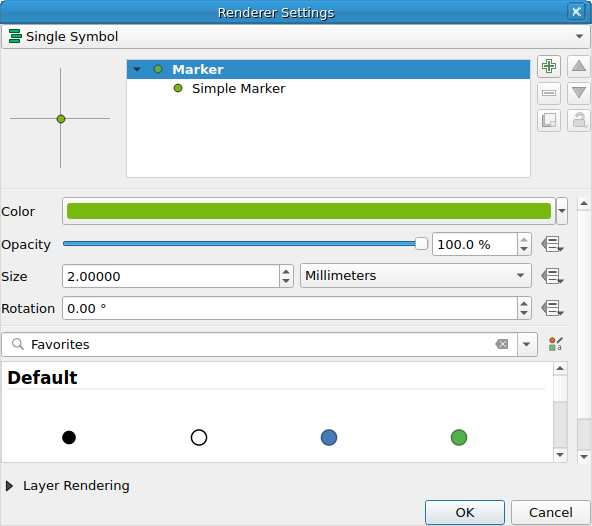
QgsRendererPropertiesDialog showing a QgsSingleSymbolRenderer in the default (dialog) mode
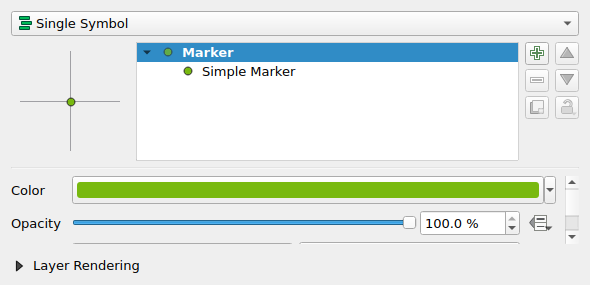
QgsRendererPropertiesDialog showing a QgsSingleSymbolRenderer in an embedded widget mode
List of all members, including inherited members
Class Hierarchy
Base classes
Constructor
Methods
Apply the changes from the dialog to the layer. |
|
Connect the value changed event for the set of widgets to widgetChanged signal. |
|
Apply and accept the changes for the dialog. |
|
Open a panel or dialog depending on dock mode setting If dock mode is |
|
called when user changes renderer type |
|
Sets the context in which the dialog is shown, e.g., the associated map canvas and expression contexts. |
|
Set the widget in dock mode which tells the widget to emit panel widgets and not open dialogs |
|
Sets the map canvas associated with the dialog. |
Signals
Emitted when expression context variables on the associated vector layers have been changed. |
|
Emit when you require a panel to be show in the interface. |
|
Emitted when something on the widget has changed. |
- class qgis.gui.QgsRendererPropertiesDialog[source]
Bases:
QDialog- __init__(layer: QgsVectorLayer | None, style: QgsStyle | None, embedded: bool = False, parent: QWidget | None = None)
Constructor for QgsRendererPropertiesDialog.
- Parameters:
layer (Optional[QgsVectorLayer]) – associated layer
embedded (bool = False) – set to
Trueto indicate that the dialog will be embedded in another widget, rather than shown as a dialog by itselfparent (Optional[QWidget] = None) – parent widget
- connectValueChanged(self, widgets: Iterable[QWidget])[source]
Connect the value changed event for the set of widgets to widgetChanged signal. Each widget is checked for type and the common type of signal is connected to widgetChanged.
- Parameters:
widgets (Iterable[QWidget]) – The list of widgets to check.
- signal layerVariablesChanged[source]
Emitted when expression context variables on the associated vector layers have been changed. Will request the parent dialog to re-synchronize with the variables.
- openPanel(self, panel: QgsPanelWidget | None)[source]
Open a panel or dialog depending on dock mode setting If dock mode is
Truethis method will emit the showPanel signal for connected slots to handle the open event.If dock mode is
Falsethis method will open a dialog and block the user.- Parameters:
panel (Optional[QgsPanelWidget]) – The panel widget to open.
- setContext(self, context: QgsSymbolWidgetContext)[source]
Sets the
contextin which the dialog is shown, e.g., the associated map canvas and expression contexts.Added in version 3.6.
- Parameters:
context (QgsSymbolWidgetContext)
- setDockMode(self, dockMode: bool)[source]
Set the widget in dock mode which tells the widget to emit panel widgets and not open dialogs
- Parameters:
dockMode (bool) –
Trueto enable dock mode.
- setMapCanvas(self, canvas: QgsMapCanvas | None)[source]
Sets the map canvas associated with the dialog. This allows the widget to retrieve the current map scale and other properties from the canvas.
- Parameters:
canvas (Optional[QgsMapCanvas]) – map canvas
- signal showPanel(panel: QgsPanelWidget)[source]
Emit when you require a panel to be show in the interface.
- Parameters:
panel (QgsPanelWidget) – The panel widget to show.
Note
If you are connected to this signal you should also connect given panels showPanel signal as they can be nested.