Class: QgsRasterMinMaxWidget
A widget for configuring how the minimum and maximum value of a raster layer is determined.
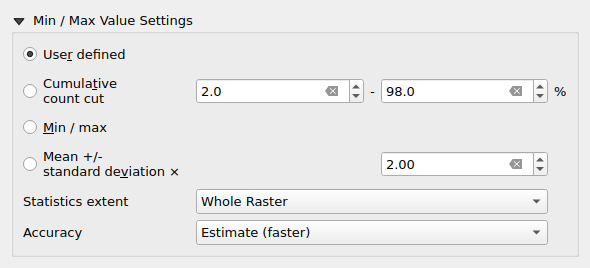
QgsRasterMinMaxWidget
List of all members, including inherited members
Class Hierarchy
Base classes
Constructor
Methods
Load programmatically with current values |
|
Returns the extent selected by the user. |
|
Hide updated extent choice |
|
Returns if the widget is collaped. |
|
Returns the map canvas associated with the widget. |
|
Returns a |
|
Returns the selected sample size. |
|
Sets collapsed state of widget |
|
Sets the extent to use for minimum and maximum value calculation. |
|
Sets the "source" of min/max values. |
|
Sets the map canvas associated with the widget. |
|
Uncheck cumulative cut, min/max, std-dev radio buttons |
Signals
signal emitted when new min/max values are computed from statistics. |
|
Emitted when something on the widget has changed. |
- class qgis.gui.QgsRasterMinMaxWidget[source]
Bases:
QWidget- __init__(layer: QgsRasterLayer | None, parent: QWidget | None = None)
Constructor for QgsRasterMinMaxWidget
- Parameters:
layer (Optional[QgsRasterLayer])
parent (Optional[QWidget] = None)
- extent(self) QgsRectangle[source]
Returns the extent selected by the user. Either an empty extent for ‘full’ or the current visible extent.
- Return type:
- signal load(bandNo: int, min: float, max: float)[source]
signal emitted when new min/max values are computed from statistics.
- Parameters:
bandNo (int)
min (float)
max (float)
- mapCanvas(self) QgsMapCanvas | None[source]
Returns the map canvas associated with the widget.
See also
- Return type:
- minMaxOrigin(self) QgsRasterMinMaxOrigin[source]
Returns a
QgsRasterMinMaxOriginobject with the widget values.- Return type:
- setExtent(self, extent: QgsRectangle)[source]
Sets the extent to use for minimum and maximum value calculation.
- Parameters:
extent (QgsRectangle) – extent in raster layer’s CRS
Note
if a map canvas is set using
setMapCanvas(), its extent will take precedence over any extent set using this method.
- setFromMinMaxOrigin(self, a0: QgsRasterMinMaxOrigin)[source]
Sets the “source” of min/max values.
- Parameters:
- setMapCanvas(self, canvas: QgsMapCanvas | None)[source]
Sets the map canvas associated with the widget. This allows the widget to retrieve the current map extent from the canvas. If a canvas is set it will take precedence over any extent set from calling
setExtent().- Parameters:
canvas (Optional[QgsMapCanvas]) – map canvas
See also