Class: QgsNumericFormatSelectorWidget
A widget which allows choice of numeric formats and the properties of them.
Added in version 3.12.
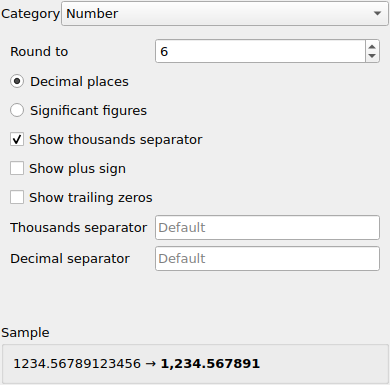
QgsNumericFormatSelectorWidget
List of all members, including inherited members
Class Hierarchy
Base classes
Base class for any widget that can be shown as an inline panel. |
|
Constructor
Methods
Returns a new format object representing the settings currently configured in the widget. |
|
Register an expression context generator class that will be used to retrieve an expression context for the widget when required. |
|
Sets the format to show in the widget. |
Signals
Emitted whenever the format configured55 in the widget is changed. |
- class qgis.gui.QgsNumericFormatSelectorWidget[source]
Bases:
QgsPanelWidget- __init__(parent: QWidget | None = None)
Constructor for QgsNumericFormatSelectorWidget with the specified
parentwidget.- Parameters:
parent (Optional[QWidget] = None)
- format(self) QgsNumericFormat | None[source]
Returns a new format object representing the settings currently configured in the widget.
The caller takes ownership of the returned object.
- Return type:
- registerExpressionContextGenerator(self, generator: QgsExpressionContextGenerator | None)[source]
Register an expression context
generatorclass that will be used to retrieve an expression context for the widget when required.Ownership is not transferred, and the
generatormust exist for the lifetime of this widget.Added in version 3.40.
- Parameters:
generator (Optional[QgsExpressionContextGenerator])
- setFormat(self, format: QgsNumericFormat | None)[source]
Sets the format to show in the widget.
- Parameters:
format (Optional[QgsNumericFormat])