Class: QgsLayerPropertiesWidget
A widget which allows configuration of the properties of a single
QgsSymbolLayer.
This widget includes a combobox box for selection of the symbol layer type, and a panel for showing configuration properties for the selected symbol layer type.
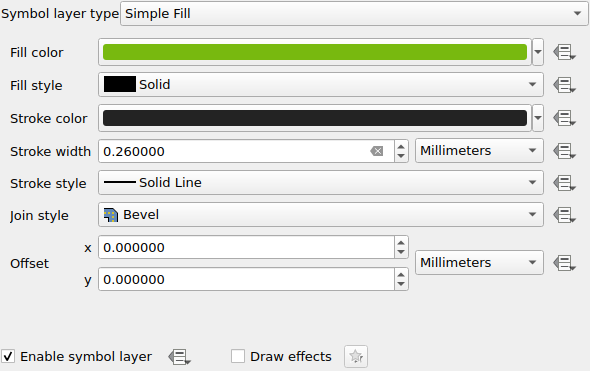
QgsLayerPropertiesWidget showing a simple fill symbol layer
List of all members, including inherited members
Class Hierarchy
Base classes
Base class for any widget that can be shown as an inline panel. |
|
Abstract interface for generating an expression context. |
Constructor
Methods
Returns the context in which the symbol widget is shown, e.g., the associated map canvas and expression contexts. |
|
Registers a data defined override button. |
|
Sets the context in which the symbol widget is shown, e.g., the associated map canvas and expression contexts. |
|
Signals
Emitted when the symbol layer is changed in the widget. |
|
Emitted when the symbol layer configuration is changed in the widget. |
- class qgis.gui.QgsLayerPropertiesWidget[source]
Bases:
QgsPanelWidget,QgsExpressionContextGenerator- __init__(layer: QgsSymbolLayer | None, symbol: QgsSymbol | None, vl: QgsVectorLayer | None, parent: QWidget | None = None)
Constructor for QgsLayerPropertiesWidget.
- Parameters:
layer (Optional[QgsSymbolLayer]) – the symbol layer
vl (Optional[QgsVectorLayer]) – associated vector layer
parent (Optional[QWidget] = None) – parent widget
- signal changeLayer(layer: QgsSymbolLayer)[source]
Emitted when the symbol
layeris changed in the widget.- Parameters:
layer (QgsSymbolLayer)
- context(self) QgsSymbolWidgetContext[source]
Returns the context in which the symbol widget is shown, e.g., the associated map canvas and expression contexts.
See also
- Return type:
- registerDataDefinedButton(self, button: QgsPropertyOverrideButton | None, key: QgsSymbolLayer.Property)[source]
Registers a data defined override button. Handles setting up connections for the button and initializing the button to show the correct descriptions and help text for the associated property.
- Parameters:
button (Optional[QgsPropertyOverrideButton])
key (QgsSymbolLayer.Property)
- setContext(self, context: QgsSymbolWidgetContext)[source]
Sets the context in which the symbol widget is shown, e.g., the associated map canvas and expression contexts.
- Parameters:
context (QgsSymbolWidgetContext) – symbol widget context
See also
- updateSymbolLayerWidget(self, layer: QgsSymbolLayer | None)[source]
- Parameters:
layer (Optional[QgsSymbolLayer])