Class: QgsLabelingEngineRulesWidget
A widget which allows configuration of a list of labeling engine rules.
This widget allows users to add, remove, and edit the properties of a
list of QgsAbstractLabelingEngineRule objects.
See also
QgsLabelingEngineRuleWidget for a widget for configuring a single rule
Added in version 3.40.
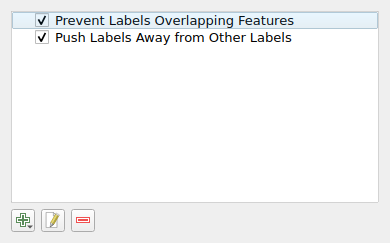
QgsLabelingEngineRulesWidget
List of all members, including inherited members
Class Hierarchy
Base classes
Base class for any widget that can be shown as an inline panel. |
|
Constructor
Methods
Returns the rules shown in the widget. |
|
Sets the rules to show in the widget. |
Signals
Emitted when the rules configured in the widget are changed. |
- class qgis.gui.QgsLabelingEngineRulesWidget[source]
Bases:
QgsPanelWidget- __init__(parent: QWidget | None = None)
Constructor for QgsLabelingEngineRulesWidget.
- Parameters:
parent (Optional[QWidget] = None)
- rules(self) list[QgsAbstractLabelingEngineRule]
Returns the rules shown in the widget.
The caller takes ownership of all returned rules.
- Return type:
- setRules(self, rules: Iterable[QgsAbstractLabelingEngineRule])[source]
Sets the
rulesto show in the widget.Ownership is not transferred, an internal copy will be made.
- Parameters:
rules (Iterable[QgsAbstractLabelingEngineRule])