Class: QgsCrsSelectionWidget
A generic widget allowing users to pick a Coordinate Reference System (or define their own).
Added in version 3.24.
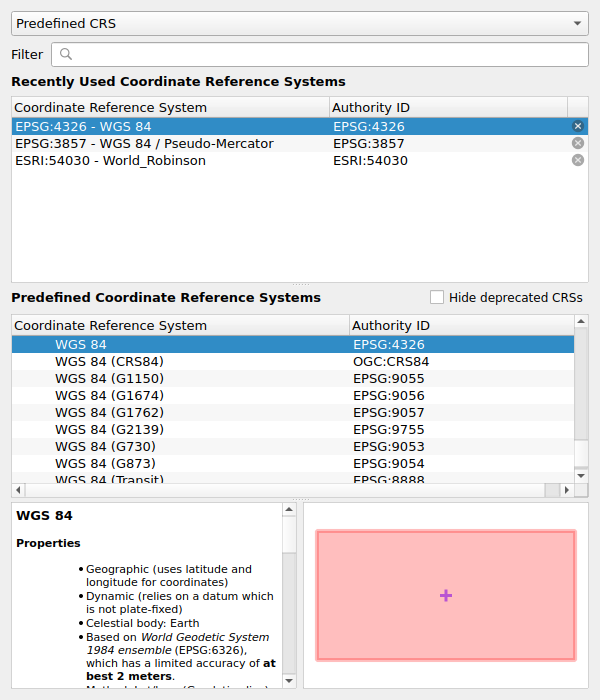
QgsCrsSelectionWidget
List of all members, including inherited members
Class Hierarchy
Base classes
Base class for any widget that can be shown as an inline panel. |
|
Constructor
Methods
Returns the CRS currently selected in the widget. |
|
Returns the filters set on the available CRS. |
|
Returns |
|
Sets whether the topocentric CRS type option is shown in the widget's CRS type combobox. |
|
Sets the crs to show within the widget. |
|
Sets filters for the available CRS. |
|
Sets a message to show in the dialog. |
|
Sets the text to show for the not set option. |
|
filters this dialog by the given CRSs |
|
Sets the visible area to use when showing a preview of the CRS in the widget. |
|
Sets whether a "no/invalid" CRS option should be shown. |
|
Returns whether the "no/invalid" CRS option is shown. |
Signals
Emitted when the CRS defined in the widget is changed. |
|
Emitted when a CRS entry in the widget is double-clicked. |
|
Emitted when the widget has a valid selection or not. |
- class qgis.gui.QgsCrsSelectionWidget[source]
Bases:
QgsPanelWidget- __init__(parent: QWidget | None = None, filters: QgsCoordinateReferenceSystemProxyModel.Filter = QgsCoordinateReferenceSystemProxyModel.FilterHorizontal | QgsCoordinateReferenceSystemProxyModel.FilterCompound)
Constructor for QgsCrsSelectionWidget, with the specified
parentwidget.Since QGIS 3.36, the optional
filterargument can be used to specify filters on the systems shown in the widget. The default is to show all horizontal and compound CRS in order to match the behavior of older QGIS releases. Thefiltercan be altered to also include vertical CRS if desired.- Parameters:
parent (Optional[QWidget] = None)
filters (QgsCoordinateReferenceSystemProxyModel.Filter = QgsCoordinateReferenceSystemProxyModel.FilterHorizontal|QgsCoordinateReferenceSystemProxyModel.FilterCompound)
- crs(self) QgsCoordinateReferenceSystem[source]
Returns the CRS currently selected in the widget.
See also
- Return type:
- signal crsDoubleClicked(crs: QgsCoordinateReferenceSystem)[source]
Emitted when a CRS entry in the widget is double-clicked.
- Parameters:
- filters(self) QgsCoordinateReferenceSystemProxyModel.Filter[source]
Returns the filters set on the available CRS.
See also
Added in version 3.36.
- Return type:
- hasValidSelection(self) bool[source]
Returns
Trueif the widget has a valid CRS defined.- Return type:
bool
- signal hasValidSelectionChanged(isValid: bool)[source]
Emitted when the widget has a valid selection or not.
- Parameters:
isValid (bool)
- setAllowTopocentricCrs(self, allow: bool)[source]
Sets whether the topocentric CRS type option is shown in the widget’s CRS type combobox. When
allowisFalse, the topocentric CRS option is hidden and cannot be selected.Added in version 4.2.
- Parameters:
allow (bool)
- setCrs(self, crs: QgsCoordinateReferenceSystem)[source]
Sets the
crsto show within the widget.See also
- Parameters:
- setFilters(self, filters: QgsCoordinateReferenceSystemProxyModel.Filter)[source]
Sets
filtersfor the available CRS.See also
Added in version 3.36.
- Parameters:
- setMessage(self, message: str | None)[source]
Sets a
messageto show in the dialog.- Parameters:
message (Optional[str])
- setNotSetText(self, text: str | None, description: str | None = '')[source]
Sets the text to show for the not set option. Note that this option is not shown by default and must be set visible by calling
setShowNoCrs().The
descriptionargument can be used to specify a detailed description which is shown when the option is selected.
- setOgcWmsCrsFilter(self, crsFilter: Iterable[str | None])[source]
filters this dialog by the given CRSs
Sets this dialog to filter the available CRSs to those listed by the given Coordinate Reference Systems.
- Parameters:
crsFilter (Iterable[Optional[str]]) – a list of OGC Coordinate Reference Systems to filter the list of CRS by. This is useful in (e.g.) WMS situations where you just want to offer what the WMS server can support.
Warning
This function’s behavior is undefined if it is called after the dialog is shown.
- setPreviewRect(self, rect: QgsRectangle)[source]
Sets the visible area to use when showing a preview of the CRS in the widget.
Added in version 4.2.
- Parameters:
rect (QgsRectangle)
- setShowNoCrs(self, show: bool)[source]
Sets whether a “no/invalid” CRS option should be shown. If this option is selected, calling
crs()will return an invalidQgsCoordinateReferenceSystem.See also
- Parameters:
show (bool)
- showNoCrs(self) bool[source]
Returns whether the “no/invalid” CRS option is shown. If this option is selected, calling
crs()will return an invalidQgsCoordinateReferenceSystem.See also
- Return type:
bool