Class: QgsActionMenu
A menu that is populated automatically with the actions defined for a given layer.
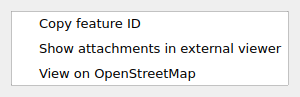
QgsActionMenu showing some sample actions for a feature
List of all members, including inherited members
Class Hierarchy
Base classes
Constructor
Classes
Methods
Returns an expression context scope used to resolve underlying actions. |
|
Returns |
|
Returns menu actions |
|
Sets a |
|
Sets an expression context scope used to resolve underlying actions. |
|
Change the feature on which actions are performed |
|
Change the mode of the actions |
Signals
Emitted when the previous message from the tool should be cleared from the application message bar. |
|
Emitted when a message should be shown to the user in the application message bar. |
|
Emitted after actions have been reloaded. |
- class qgis.gui.QgsActionMenu[source]
Bases:
QMenu- __init__(layer: QgsVectorLayer | None, feature: QgsFeature, actionScope: str | None, parent: QWidget | None = None)
Constructs a new QgsActionMenu
- Parameters:
layer (Optional[QgsVectorLayer]) – The layer that this action will be run upon.
feature (QgsFeature) – The feature that this action will be run upon. Make sure that this feature is available for the lifetime of this object.
parent (Optional[QWidget] = None) – The usual QWidget parent.
actionScope (Optional[str]) – The action scope this menu will run in
- __init__(layer: QgsVectorLayer | None, fid: int, actionScope: str | None, parent: QWidget | None = None)
Constructs a new QgsActionMenu
- Parameters:
layer (Optional[QgsVectorLayer]) – The layer that this action will be run upon.
fid (int) – The feature id of the feature for which this action will be run.
parent (Optional[QWidget] = None) – The usual QWidget parent.
actionScope (Optional[str]) – The action scope this menu will run in
- class ActionData
- class ActionData(action: QgsAction, featureId: int, mapLayer: QgsMapLayer | None)
- class ActionData(action: QgsMapLayerAction | None, featureId: int, mapLayer: QgsMapLayer | None)
- class ActionData(a0: QgsActionMenu.ActionData)
Bases:
object- actionData
- actionType
- featureId
- mapLayer
- class ActionType(*values)
Bases:
IntEnumAction types.
Prior to QGIS 3.30 this was available as
QgsActionMenu.ActionTypeAdded in version 3.30.
Invalid: InvalidMapLayerAction: Standard actions (defined by core or plugins), corresponds toQgsMapLayerActionclass.AttributeAction: Custom actions (manually defined in layer properties), corresponds toQgsActionclass.
- expressionContextScope(self) QgsExpressionContextScope[source]
Returns an expression context scope used to resolve underlying actions.
- Return type:
- isEmpty(self) bool[source]
Returns
Trueif the menu has no valid actions.Added in version 3.30.
- Return type:
bool
Returns menu actions
Added in version 3.12.
- Return type:
list[QgsAction]
- signal messageDiscarded[source]
Emitted when the previous message from the tool should be cleared from the application message bar.
See also
Added in version 4.0.
- signal messageEmitted(message: str, level: Qgis.MessageLevel = Qgis.MessageLevel.Info)[source]
Emitted when a
messageshould be shown to the user in the application message bar.See also
Added in version 4.0.
- Parameters:
message (str)
level (Qgis.MessageLevel = Qgis.MessageLevel.Info)
- setActionContextGenerator(self, generator: QgsMapLayerActionContextGenerator | None)[source]
Sets a
QgsMapLayerActionContextGeneratorto create action contexts for the menu.The
generatorobject must exist for the lifetime of the menu.Added in version 3.30.
- Parameters:
generator (Optional[QgsMapLayerActionContextGenerator])
- setExpressionContextScope(self, scope: QgsExpressionContextScope)[source]
Sets an expression context scope used to resolve underlying actions.
- Parameters:
scope (QgsExpressionContextScope)
- setFeature(self, feature: QgsFeature)[source]
Change the feature on which actions are performed
- Parameters:
feature (QgsFeature) – A feature. Will not take ownership. It’s the callers responsibility to keep the feature as long as the menu is displayed and the action is running.
- setMode(self, mode: QgsAttributeEditorContext.Mode)[source]
Change the mode of the actions
- Parameters:
mode (QgsAttributeEditorContext.Mode) – The mode of the attribute form